
Calendly’s Top Lessons from 200+ Win-Loss Interviews
Calendly’s top lessons from over 200 win-loss interviews, presented by Clozd, highlight the importance of live and AI-powered customer feedback programs, win-loss analysis, and integrated, secure platforms to uncover real reasons behind sales outcomes and improve decision-making.
Feedback Collection
Live Interviews\ \ The most powerful feedback channel AI Interviews\ \ Scale your customer feedback program
The Clozd Advantage
Platform Overview\
\
Turn customer feedback into action  \
\
Program Experts\
\
Expert guidance, better customer insights
Features
MCP\ \ Clozd's custom, AI-powered search tool Integrations\ \ Connect Clozd with your other everyday tools Security\ \ Clozd is ISO 27001 and 27701 certified
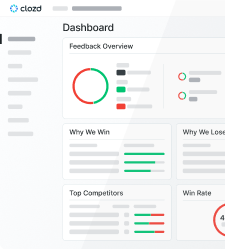
Learn more about our innovative platform\
\
 \
\
Book a demo
Decision Points
 \
\
Win-Loss Analysis\
\
Uncover the real reasons you win and lose Churn Analysis\
\
Eliminate the high cost of customer churn Customer Experience Feedback\
\
Build stronger customer relationships
Teams
Sales\ \ Boost your team's productivity and performance Marketing\ \ Learn how Clozd helps marketers build influence Product\ \ Uncover needs, shape better features Customer Success\ \ Improve retention and drive expansion
Resources
Resource Library\ \ Your hub for insights across the customer journey Clozd Blog\ \ Access game-changing content from our team of experts Customer Stories\ \ See how real companies are using customer feedback The Ultimate Guide to Win-Loss Analysis\ \ Every question about win-loss analysis answered ROI Calculator\ \ See how much you can increase your revenue
 \
\
Tailored interviews conducted by certified industry veterans\
\
Check it out
Company
About Us\ \ Learn more about our vision, values, and culture Careers\ \ Help us build the future of customer conversations
Why Clozd


Product
Solutions
Resources
Company

Back
product
\
\
Win-Loss Analysis\
\
 Implementation Feedback\
\
Customer Experience Feedback\
\
Churn Analysis\
\
Other Use Cases
Market Research\
\
Product Research\
\
Feedback Collection
Live Interviews\
\
Flex Interviews\
\
The Clozd advantage
Platform Overview\
\
\
\
Expert Services\
\
Back
Teams
Sales\
\
Marketing\
\
Product\
\
Customer Success\
\
Features
Integrations\
\
Security\
\
Clozd MCP\
\
Expert Network\
\
Back
Resources
Resource Library\
\
Clozd Blog\
\
Customer Stories\
\
The Ultimate Guide to Win-Loss Analysis\
\
ROI Calculator\
\
Back
Company

Calendly’s top lessons learned from 200+ win-loss interviews from Clozd on Vimeo

Playing in picture-in-picture
More options
Like
Add to Watch Later
Play
00:00
08:18
CC/subtitles
Settings
Speed
Transcript
Picture-in-Picture
Fullscreen
Show controls
QualityAuto
CC/subtitlesOff
2x
1.5x
1.25x
1x
0.75x
0.5x


Calendly’s top lessons learned from 200+ win-loss interviews
Heather Pepe
Senior Manager, Solutions Marketing at Calendly
In this interview, Heather—who’s been running Calendly’s internal win-loss analysis program for the past three years—talks about the value of voice-of-customer insights, how to capture and share the most impactful insights, and how their win-loss program has evolved over time to meet their changing needs.
In this discussion, Heather Pepe, who leads product marketing at Calendly, shares insights into how they leverage win-loss analysis to drive organizational change. With nearly three years of experience running this program, Heather began by conducting a listening tour across sales, customer success, marketing, and product teams to understand what insights would be most beneficial.
The win-loss program has evolved to align with business changes, such as leadership shifts or new company objectives. With over 200 interviews conducted, including an ICP-specific program and async interviews, Heather emphasizes the importance of incorporating customer feedback into decision-making. She has received strong support from the executive team, particularly the CRO, which has helped gain buy-in from other stakeholders.
To engage teams with the win-loss data, Heather employs Slack for real-time updates and conducts quarterly readouts. Recently, they’ve adopted roadshow-style presentations for smaller groups to foster collaboration and engagement.
Heather advises new program leaders to seek executive sponsorship, understand stakeholder needs through listening tours, and continuously communicate the program's value. For effective buy-in, she recommends targeting leaders passionate about customer feedback, creating a solid business case, and adapting the program to meet evolving business needs. Overall, she highlights the importance of using win-loss insights to improve the customer experience and sales processes at Calendly.
Expand
See less
Q&A
Clozd: We’re excited to be here with Heather Pepe from Calendly. Heather, can you tell us a little bit about yourself?
Heather Pepe: Sure. I sit within product marketing at Calendly, and I lead our solutions and customer marketing teams. We're responsible for solutions, programs, and campaigns that target our key ICPs. That includes messaging and positioning. Also, we create collateral for our sales and CS teams. We also conduct market research through win-loss, through third-party site data, and through competitive intelligence. And then on the customer marketing side, we're really responsible for voice-of-the-customer and customer advocacy. That includes our customer stories, our testimonials, and our events.
You've been running this win-loss program for almost three years now. What's changed from when you first took it over to where it is now?
When I started the program at Calendly, I did a listening tour with our sales, customer success, marketing, and product teams to really uncover what would be most valuable for them to hear from the win-loss program. As Calendly has evolved over the past three years … we've really adapted the program to those business changes. For instance, if we've had a change with our sales leadership, or we sunset a product, or we've had a shift in our company objectives, that's when we'll make changes to the program to adapt to those company changes. As we have new leaders and new stakeholders involved in the program, that's when I'll introduce it to them, get buy-in, and then we'll make changes to our interview guide, for instance, and maybe focus on a certain type of buyer or a certain product that will help us align better with Calendly's company objectives.
I've also been fortunate to have advocates on the executive team. I know that they're reading all the interviews as they come through, and our CRO, in particular, has been a big proponent of the program and getting buy-in from the rest of the executive team. At this point, we've run several programs with Clozd. We have our traditional win-loss program, and we've done over 200 interviews for that. And then we've also run an ICP-specific program, where we were targeting those key buyers. Most recently, we've been using the Flex Interviews—which are the async audio and video interviews—to really understand those buyers on the PLG side of the business.
How do you get stakeholders involved, some of these other users, into the platform? What's been your best practice?
I think it's delivering the information to them in Slack, where a lot of us work in Calendly, and then getting buy-in from the leadership team. Recently, we added all of our sales team into Clozd. Previously, we only had managers and leadership in the program, so it's getting that buy-in from the leaders and then having that trickle down to the stakeholders within the org.
That’s kind of a big change. Some of the companies we work with avoid giving salespeople access to the platform. Has it been a good change? Are they receptive to the feedback and the interviews?
Yes, very. I know when we did our readout last week to the sales and marketing teams, we had a lot of engagement from the reps on the call. They seem to find the insights very valuable and are using those learnings to improve their own sales process.
Okay. Heather, you mentioned you've done over 200 interviews since you've taken over—in addition to the Flex Interviews. What are some of the themes and the trends that you're seeing, and how are you addressing those?
At Calendly, our voice-of-the-customer and qualitative data are so important, where now it's a company priority to really bring in that voice-of-the-customer data and feedback into every business decision. Direct customer feedback is so important for teams, like our sales and CS teams, where we can really understand where those challenges and blockers are. Then we can then make changes to our own processes to really improve the customer experience.
On the PLG side of the business, it's really understanding those challenges and blockers within that customer journey, and how we can make improvements to that first-time user experience.
We're also using the dashboards and tagging within Clozd to really view trends across a period of time and determine things like Decision Drivers that we're winning and losing deals to or competitors we're coming up against. Then we're reporting that information back to the company and also encouraging users to log into the Clozd Platform.
There's obviously so much that goes into running a win-loss program—on top of all the other aspects of your role. How do you find time to share win-loss insights across the organization?
We have a dedicated win-loss Slack channel. The interviews populate as soon as they're published in real time, and we also conduct quarterly readouts. And for this quarter, we're actually trying something different. Right now we're doing roadshow-style presentations with specific departments, so smaller groups versus one large readout to create more engagement and collaboration. This gives everyone the opportunity to ask questions and talk about actionable next steps.
It's been fun to watch your program grow and develop. I love how you've evolved over time. If you were talking to someone who’s new to win-loss analysis, what advice would you give them so they could build a successful program like Calendly does?
I would say first is executive sponsorship, really leaning into the executive who you'd get the most buy-in for the program. And then we can have that top-down approach, where they really socialize the value of it. And then I would say meet with all the stakeholders. Just do a listening tour, really figure out what would be most valuable for them to learn from this customer feedback and all the interviews. And then continue to communicate with those teams—whether it's Slack or email, wherever you meet—and really prove the value of the program that way, by providing that feedback loop and that actionable data back to those teams.
If you were going to start and try to get buy-in from one group, who would you suggest?
I'd say for sales, the CRO. At Calendly, we have a chief customer officer who runs our CS and CX teams. I would say to just find a leader who's really passionate about voice-of-the-customer and that qualitative feedback.
As far as getting buy-in, I would say creating a business case or a one-pager and really thinking through the strategy for the program and how it will provide value and benefits back to the business. Once you justify that, it's a matter of trying it out and then looking at those actionable insights and seeing what value it provides back to the team. That's how you can start. As I mentioned, our program has evolved, and you can continue evolving and adapting yours to your business needs.


©2026 Clozd Inc.
Company
Resources
Win-Loss Content
The Ultimate WIn-Loss Analysis Guide
Guide to Building a Win-Loss Program
State of Win-Loss Analysis Report
Company
About Us Careers Talk With Us Log In
Resources
Win-Loss Guide GDPR Compliance Privacy Policy Terms Of Use
Popular Blog Posts
Learn Win-Loss: Resources Win-Loss Analysis Guide State Of Win-Loss Analysis Report
©2025 Clozd Inc.
By continuing to browse our site, you consent to our use of cookies. Privacy Policy